

Research Scope
This section contains domain details of EasyTalk
LITERATURE SURVEY
Researches related to sign languages are done around the world. Chinese sign language, American sign language, and Sinhala are some of them. These sign language detections have two approaches. One is image or vision-based and the other one is device-based. In general, the identification of signs includes pre-processing, extraction of features, and classification in a simple phase. Pre-processing is done in the sense to remove an unwanted element from the context. From the Region of Interest (ROI), image feature will be extracted, and it will be classified using a certain method.
When talking about device-based sign recognition, a system is proposed by Gibran & team for Mexican sign language using Kinect sensor. The system will store the colour, depth and the skeleton tracking information using the RGB-D camera. Dynamic Time Wrapping (DTW) algorithm had been used in this system to interpret gestures.
Haar Cascade Classifier has shown 92.68% accuracy in Kanchan & Surekha’s work. They have interpreted Indian sign language using webcam images. However, some images are not classified because of high motion gestures. For the same sign language, Probabilistic Neural Network (PNN) classifier has shown more accuracy than K-Nearest Neighbor (KNN) classifier.

RESEARCH GAP
The first reason is Sri Lanka still listed as a developing country. The tools & technologies which were used to build such systems by other countries are very expensive nowadays. Sri Lankan government cannot be able to spend that amount of money for only one main purpose. The second reason is that even we buy one of those system, people cannot get the benefits of the system as each country has their own sign language.
Another reason is that, the system which already implemented for a specific language such as Sinhala. Due to this reason, if any person who doesn’t have a proper practice in that language won’t understand the system. Therefore,by-today the ordinary people who are willing to communicate with hearing-impaired & mute people have challenged with a huge communicating gap in their daily lives.

RESEARCH PROBLEM
- Sri Lanka relies on tourism and education for its growth.
- Reliable communication between every citizen is key for country’s growth
- The verbal and hearing impaired need a reliable and an easy go-to solution.
- Such a translating solution should increase such person’s value

OBJECTIVES
MAIN OBJECTIVE
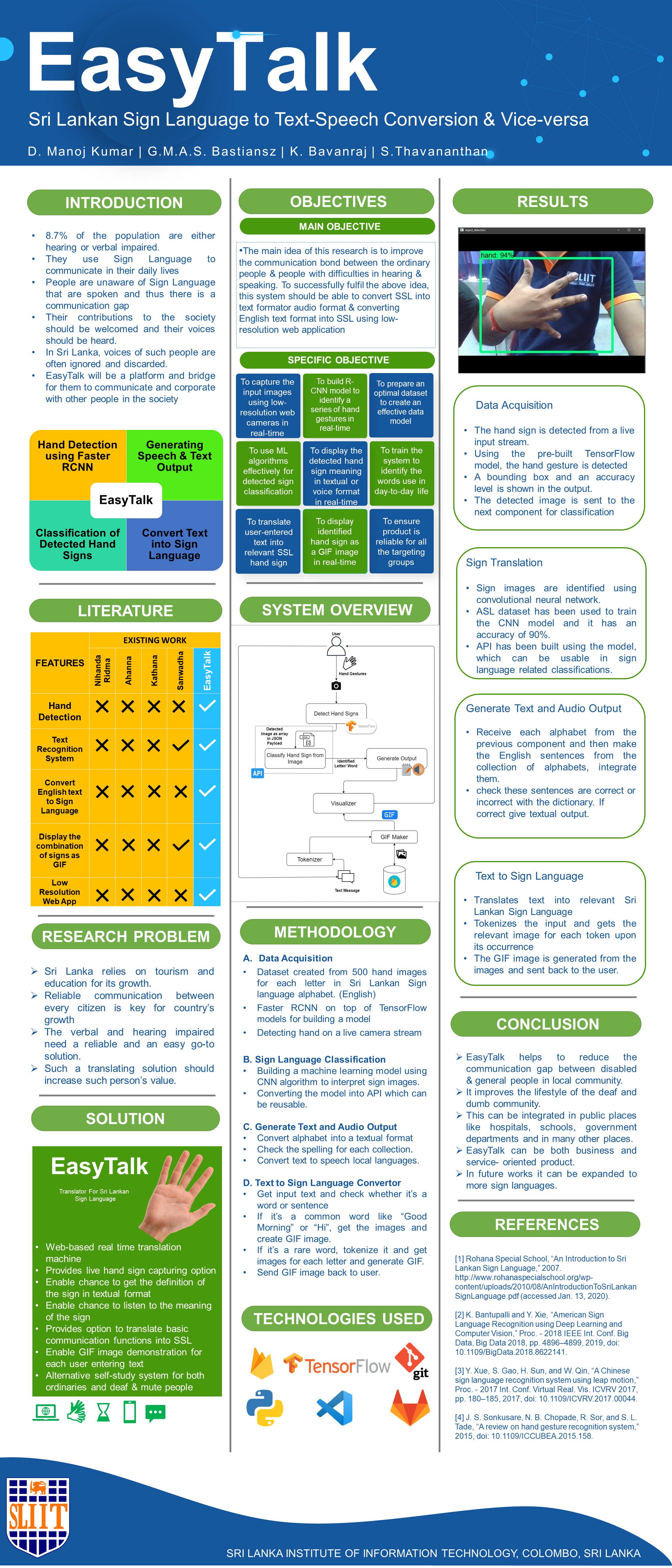
- To improve the communication bond between the ordinary people & people with difficulties in hearing & speaking. To successfully fulfil the above idea, this system should be able to convert SSL into text formator audio format & converting English text format into SSL using low-resolution web application.
SPECIFIC OBJECTIVES
- To capture the input images using low-resolution web cameras in real-time.
- To use ML algorithms effectively for detected sign classification
- To display the detected hand sign meaning in textual or voice format in real-time
- To translate user-entered text into relevant SSL hand sign
METHODOLOGY
Data Acquisition:
- Creating Dataset using 500 SSL hand images
- Building a model using Faster RCNN
- Detecting user-images on a live camera stream
Sign Language Classification:
- Building a model using CNN to interpret signs
- Checking the accuracy of the user's hand image
- Creating an API to fetch the identified letters
Text-Audio Output Generation:
- Converting output into a textual format
- Checking the spelling mistakes in each collection
- Converting output into audio-format
Text to Sign Language Convertion:
- Detecting user-inserted text using NLP
- Building a model to identify relevant signs for a text
- Creating a GIF images using hand signs
TECHNOLOGIES USED



Research Milestone
This section has details about EASY TALK project
12%Project Proposal
Presentation: 6% | Proposal Report: 6%
The explaination how individual components are developing within the year to achieve the final research product.
Progress Presentation I15%
A live demonstration with a presentation to justify the 50% completeness of the research product.
18%Progress Presentation II
Presentation: 12% | Code Evaluation: 6%
A live demonstration with a presentation to justify the 90% completeness of the research product.
DemoView Demo
The video-captured demonstration to present the final view of the completed research product.
29%Final Assessment
Presentation: 10% | Final Reports: 19%
The final detailed demonstration of the product which was done as the last stage of the research.
Viva37%
PP I: 15% | PP II: 12% | Final Presentation: 10%
The questionaire session with the research panel based on the flow of the research, EasyTalk.
Research Documents
This section includes already-produced documents and the documents which are pending to produce.
Project Charter Document
The formal documentation which used to share the understanding of the project’s scope, development, and objectives, while defining the roles and responsibilities of each member involved.
Proposal Document
A detailed documentation which gives an idea to the audience of what problems EasyTalk intends to address and the methods through which intend to achieve the goal. This describes desired product's results and several quality constraints.
Research Log Book
An online record book which used to record daily meetings conducted with supervisor and co-supervisor regarding the research's works. The daily updates in the GitLab accounts were also reported with the intension of tracking the improvements in the future.
Status Document I
Status Document-I was maintained individually while containing all the details about the current progress of each individual component. To prove the progresses the Gantt charts, WBSs, components' milestones and the details of the meetings with the supervisor were presented.
Status Document II
Status Document-II also maintained individually and contains same cotents as Status documet I. Additionally, this documents contains the acceptance letters got from the conferences.
Final Reports
Five detailed documentations contain information about the overall product and it's 4 main components respectively. Each report evaluates how the research was executed, being honest and objective.
Research Presentations
This section contains all the slides of presentations based on the research.
Proposal Presentation
View PresentationProgress Presentation I
View PresentationProgress Presentation II
View PresentationFinal Presentation
View PresentationAbout Team
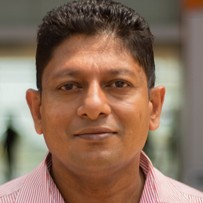
S.M.B. Harshanath
Supervisor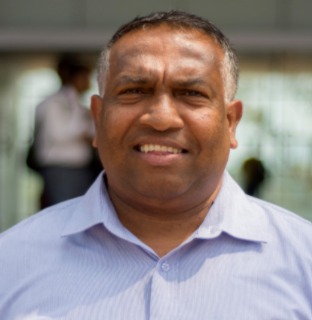
Jesuthasan Alosius
Co-Supervisor
D. MANOJ KUMAR
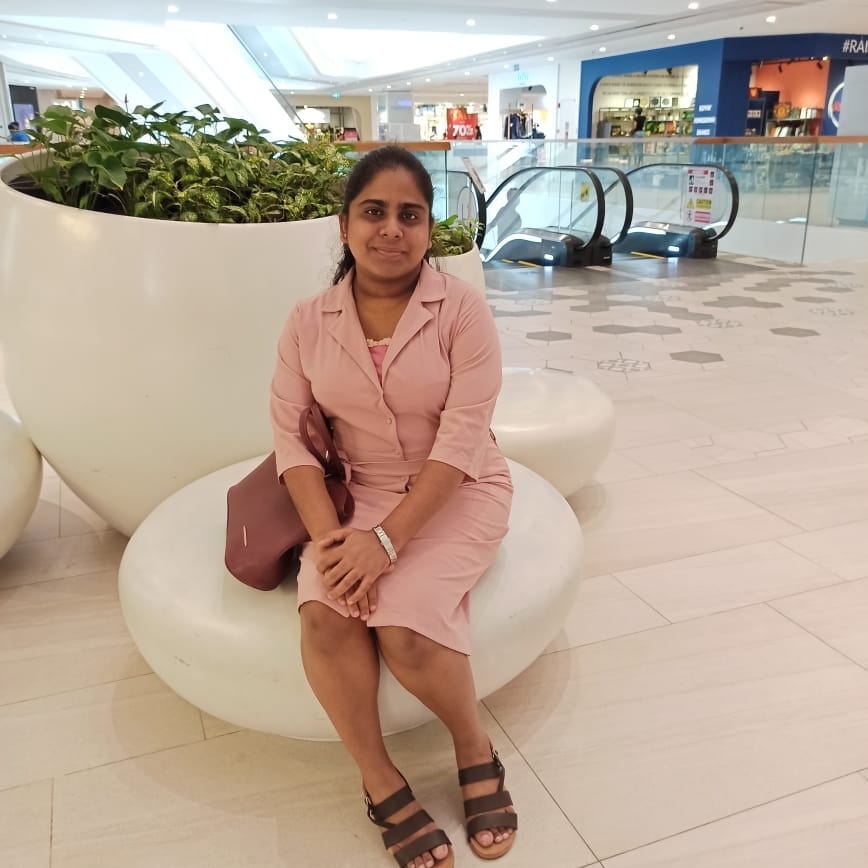
Amashi BASTIANSZ
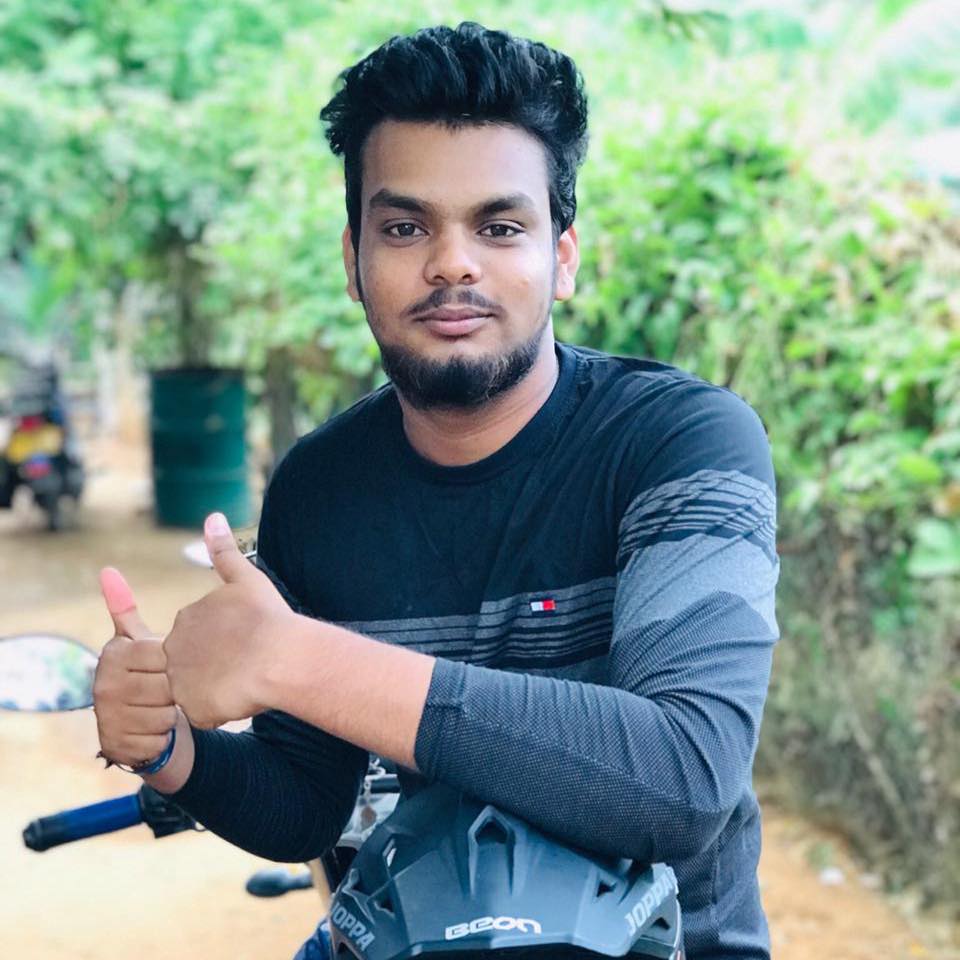
S. THAVANANTHAN
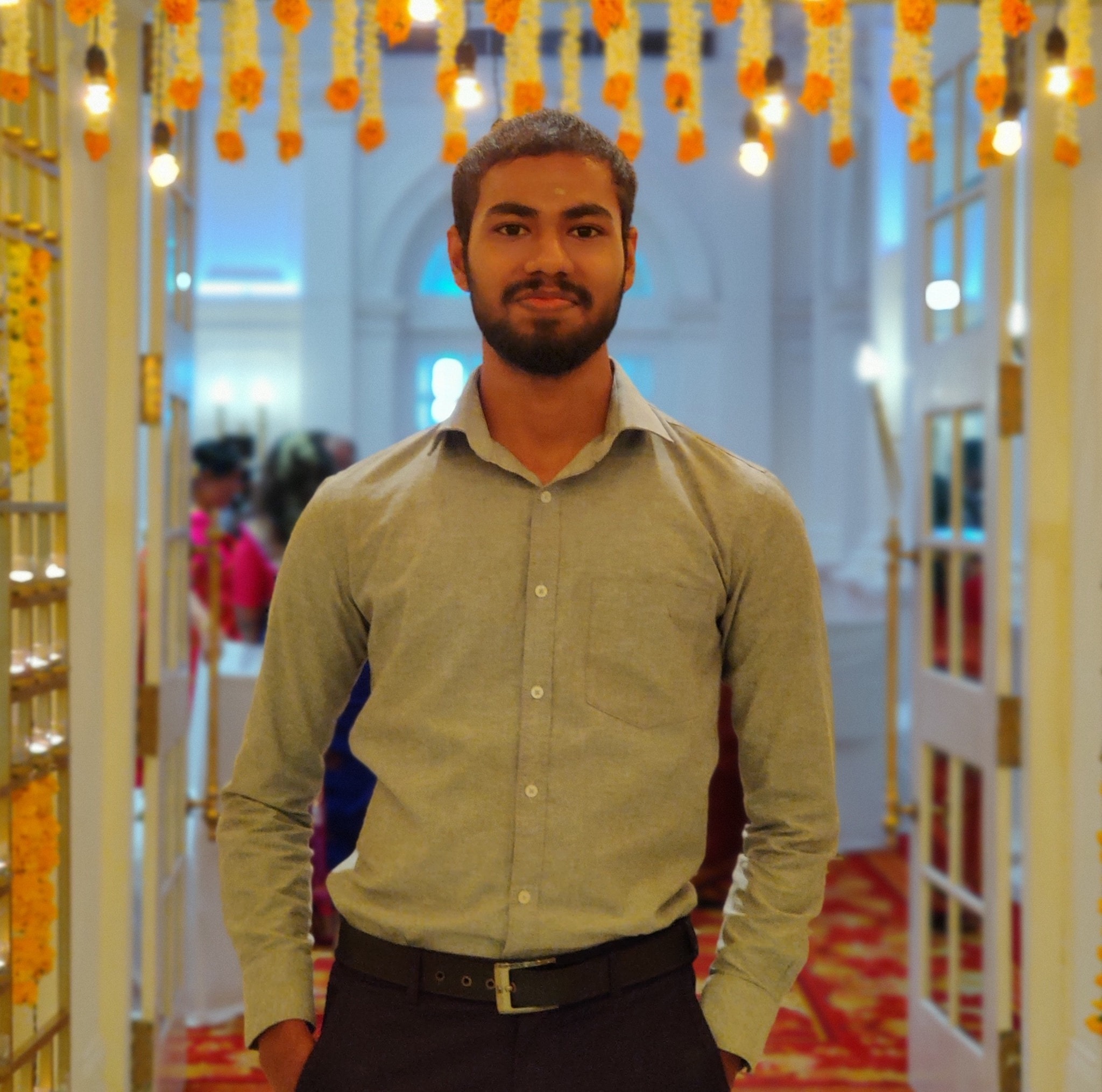
K. BAVANRAJ
Contact Us
easytalk202077@gmail.com
+94 76 760 1447
+94 71 648 2724